The Nkem Okoye
Marketing for Lawyers Made Easy
How 500+ Nigerian Lawyers Are Quietly Getting Clients From LinkedIn, Instagram, Facebook, Referrals, and Their Online Presence — Without Violating a Single Professional Conduct Rule

You won that case last year. The property dispute. The one where the family almost lost their father's land in Ikoyi.
You drafted the brief. You argued the motion. You won.
Your client shook your hand, paid your fee, and went home relieved. And that was it. Nobody else heard about it. Not the business owners in Lekki who need a property lawyer right now. Not the startup founder in Victoria Island whose lease agreement has three red flags she can't see. Not the people asking around in WhatsApp groups: "Do you know a good lawyer?"
Just you, the client, and the judge.
Meanwhile, there's Kunle.
You went to Law School together. You've seen his briefs. They're... fine. Average, if you're being honest. But Kunle posts on LinkedIn three times a week. Short videos. Commentary on new regulations. Little breakdowns of recent judgments. And last month, a fintech company retained him. Not because he's the best lawyer they could find. Because he's the only one they could find.
You scroll past his posts and feel that tight thing in your chest. It's not jealousy exactly. It's something worse. It's the recognition that he figured out something you haven't.
I should be doing that. I should be the one getting those calls. My work is better than his. But nobody knows I exist.
You've thought about posting on LinkedIn. You've opened the app, stared at the blank compose box, typed three sentences of dense legal analysis, deleted them, and closed the app. Twice. Maybe three times.
You hired a social media person once. She charged N70,000 a month and posted Canva quote graphics that said things like "Justice delayed is justice denied" over a sunset background. It was embarrassing. You got zero enquiries. You cancelled after three months and felt like you'd set N210,000 on fire.
Your website has a stock photo of a gavel on the homepage. You paid N300,000 for it. You've had it for two years. You can count the enquiries it's generated on one hand. Two of those were spam.
Someone told you "good work speaks for itself." You believed that for a while. But your good work has been speaking to an empty room for six years now.
And every month, you watch another less skilled but more visible lawyer land the retainer, the speaking invitation, the media quote, the client that should have been yours.
If any of this sounds like your practice right now, stop scrolling. What I'm about to share took me 4 years and 500+ lawyer consultations to figure out.
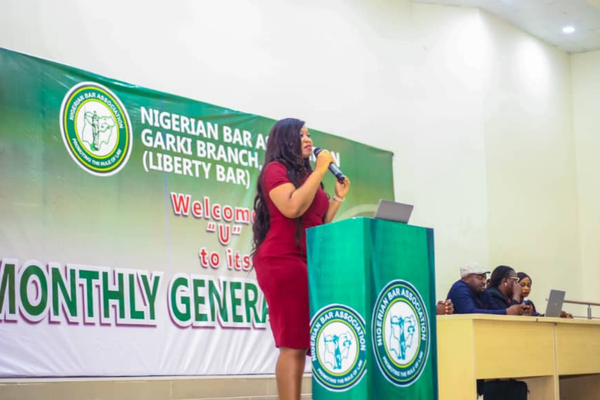
Hi. My name is Nkem Okoye. I'm a lawyer. Called to the Nigerian Bar. And for the last few years, I've been doing something law school never prepared any of us for: figuring out how lawyers actually get clients online.
I've worked with over 500 lawyers on this exact problem. Solo practitioners in Lagos. Associates in Abuja building their own names. Small firm principals in Port Harcourt. Corporate lawyers in London repositioning themselves. Lawyers across property, family, commercial, criminal, employment, immigration, and IP law.
The pattern is always the same. Brilliant lawyers. Solid track records. Completely invisible. And convinced that either (a) marketing is beneath them, (b) the Rules of Professional Conduct won't allow it, or (c) they're just "not the social media type."
All three are wrong. And I've spent years proving it.
I'm not a marketing guru. I'm not a life coach telling you to "show up authentically." I'm a lawyer who understands how this profession works from the inside, and I've built a system that gets practicing lawyers visible, retained, and fully booked without them violating a single rule or posting a single cringeworthy thing online.
Let me tell you how this started.
A few years ago, a friend from Law School called me. Let's call her T. She's sharp. Top of our set. The kind of lawyer who drafts a brief that makes opposing counsel nervous. But when she called me that evening, she sounded tired.
"Nkem, I haven't had a new client in six weeks. I'm doing good work. But the phone just isn't ringing. I don't know what to do."
At the time, I was deep into content strategy and digital marketing — working with coaches, consultants, service providers. Helping them build online visibility and attract clients through content. It was going well. But when T called, something clicked.
She didn't need a marketing degree. She needed someone who understood the legal profession and knew how visibility actually works online. She needed both worlds. And I happened to live in both.
So I offered to help. No charge. I just said, "Let me look at your LinkedIn, your Instagram, and your online presence and tell you what I'd change."
What I found was what I'd later find with nearly every lawyer I worked with.
Her LinkedIn headline said: "Legal Practitioner | Property Law | Commercial Law | Family Law." A list. Not a position. Nobody reading that would think "I need to call this person." They'd think "this person does... things?"
Her About section read like a CV. Her posts — the two she'd made in two years — were 800-word legal analyses that read like journal articles. One got 4 likes. The other got 3. One of those likes was from me. Her Instagram was worse. Personal photos mixed with the occasional legal quote graphic. No clear positioning. No content strategy. Nothing that said "hire me."
Her website had a gavel stock photo. (Why do all lawyer websites have gavel stock photos?) A generic "About Us" with her CV pasted in. A contact form that had collected exactly zero enquiries.
I rewrote her LinkedIn profile. Cleaned up her Instagram. Changed her headlines. Rewrote her About sections. Gave her a simple content framework — 3 types of posts, rotate weekly across both platforms, each one takes 15 minutes to write. Showed her how to talk about her work without violating client confidentiality. Showed her what Rule 39 actually says versus what she assumed it said.
Within 3 weeks, she got her first client enquiry from LinkedIn. A week later, another one came through Instagram.
The LinkedIn one was a business owner who saw her post about red flags in commercial lease agreements. He sent a DM: "I'm looking at a lease for a new office in VI. Can we talk?" The Instagram one was a woman going through a property dispute who found T's page through a hashtag search.
T called me that evening. I could hear the disbelief in her voice.
"Nkem. Two people found me online and want to pay me. How?"
I laughed. Because it wasn't magic. It was a system. A specific set of changes, applied in a specific order, that made her visible to the people who already needed a lawyer like her. They were out there the whole time. They just couldn't find her.
Word spread. Lawyers talk. T told a colleague. That colleague told two more. Someone saw an Instagram ad and joined my email list. Within a few months, I was getting WhatsApp messages from lawyers I'd never met: "I heard you helped T with her LinkedIn and Instagram. Can you help me?"
I started helping more. Then more. And the pattern kept repeating.
Every lawyer had tried the same things. Every one of them had failed.
They'd posted on LinkedIn once and got 3 likes. They'd hired a social media person who posted Canva quotes. They'd built a website that did nothing. They'd attended a "personal branding" workshop run by a life coach who said "be authentic" thirty times without explaining what that means when you're bound by the Rules of Professional Conduct. They'd asked a senior colleague who said "good work speaks for itself."
And every lawyer had the same three fears: I don't want to look desperate. I don't want to look unserious. I don't want to get a query from the Bar.
Fair fears. But wrong conclusions.
Because here's what I discovered after working with 500+ lawyers: the problem isn't that lawyers can't market themselves. The problem is that everything lawyers have been taught about marketing comes from the wrong world.
The coaching world. The e-commerce world. The motivational speaker world. Instagram influencer tactics. Facebook ad funnels designed for selling courses. TikTok strategies for personal brands.
None of it was built for a profession with advertising restrictions, a culture of professional dignity, and clients who judge you by your credibility before they judge you by anything else.
Lawyers don't need a "personal brand." They need a visibility system designed for how lawyers actually work, how their clients actually find them, and what the Rules actually allow.
So I built one.
I started documenting what worked. Which LinkedIn posts generated client enquiries (not just likes — actual enquiries). Which profile elements made the difference. What kind of content made a lawyer look credible without looking salesy. How to talk about wins without naming clients. How to generate referrals systematically instead of hoping your uncle mentions you at church. How to make a website actually produce enquiries instead of sitting there like an expensive gavel photo.
I tested it across practice areas. Property law. Family law. Criminal law. Commercial law. Employment law. Immigration. IP. Corporate advisory. Every area has slightly different dynamics, but the core system works across all of them because the underlying problem is the same: competent lawyer, invisible practice.
Let me tell you about three lawyers who implemented the system. I won't use their real names.
F. is a property lawyer in Lagos. She hadn't posted on LinkedIn in over 2 years when she reached out to me. She was getting clients exclusively through her church network and a few referrals from former colleagues. We rewrote her positioning, built her content framework, and clarified exactly what she could and couldn't do under the RPC. Six weeks later, she was averaging 3 new enquiries a month from LinkedIn alone. Not likes. Not comments. People sending her DMs saying "I saw your post. I need a property lawyer."
B. is a family lawyer in Abuja. Her biggest fear was Rule 39. She'd read it once, got scared, and decided that any form of online visibility was too risky. She was convinced that even having a professional LinkedIn profile could be interpreted as solicitation. I showed her the Green/Yellow/Red framework — what's clearly allowed (green), what requires caution (yellow), and what's genuinely off-limits (red). She was shocked at how much was green. She now posts weekly. She gets 3-4 new enquiries per month from her online content. And she hasn't received a single query from the Bar. Because she's not doing anything wrong. She never was. She just thought she was.
O. is a criminal law practitioner in Port Harcourt. He's 45. Old school. When a younger colleague suggested he "get on social media," he said — and I'm quoting — "social media is for unserious lawyers." Then he watched that same colleague land a major corporate retainer because a CEO found his LinkedIn article about regulatory compliance. O. called me that week. We implemented the system. Within 2 months, he was getting calls from people who "saw his post." He told me recently: "Nkem, I used to think visibility was for young lawyers. Now I think it's for smart ones."
These aren't outliers. They're the pattern. I've watched it happen hundreds of times now.
But here's the thing. I can't work with every lawyer one-on-one. The DMs, the WhatsApp messages, the emails — they come in every day. "Nkem, what do I post?" "Nkem, is this allowed under Rule 39?" "Nkem, can you look at my LinkedIn?" "Nkem, how do I get clients without begging?"
The same questions, over and over. From lawyers in Lagos, Abuja, Port Harcourt, Benin, Enugu. From Nigerian lawyers in London, Houston, Toronto, Calgary.
I kept giving the same answers. So I finally did what I should have done a long time ago.
I put everything inside one system.
I took every framework, every template, every cheat sheet, every script, every planner — everything I've used with 500+ lawyers — and packaged it into one comprehensive, step-by-step guide.
No fluff. No motivation. No "believe in yourself" sections. Just the system. What to fix, in what order, how to do it, and how to stay within the Rules while doing it.
Introducing...
From Unknown Expert to Fully Booked:
The Legal Practice Visibility System
A Step-by-Step System for Getting Clients to Come to You Ethically, Consistently — Without Becoming a Social Media Influencer.
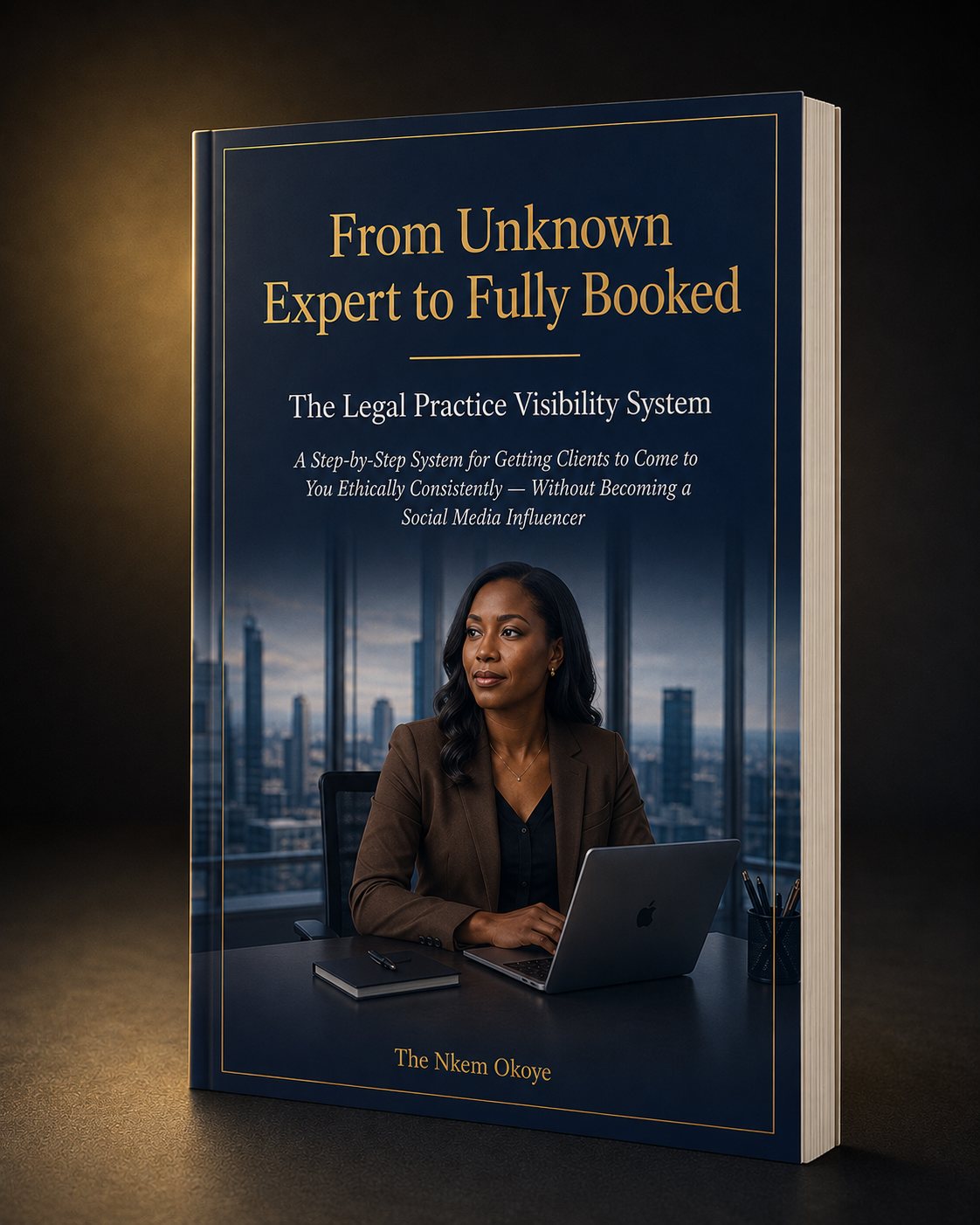
Inside this system, you'll find:
The 5 Visibility Gaps keeping competent lawyers invisible — and how to close each one in order. Most lawyers try to fix everything at once. This shows you the exact sequence that produces results fastest.
The 15-Minute Positioning Statement Exercise — gives you a one-sentence answer to "what kind of law do you practice?" that makes the listener immediately think of someone they know who needs your help. No more vague lists of practice areas.
The Professional Conduct Cheat Sheet: A Green/Yellow/Red traffic light system — showing exactly what Nigerian lawyers (and UK/US lawyers) can and cannot do when marketing themselves, with specific rules cited. No more guessing. No more fear.
15 Authority Signals that make you look credible online — ranked by effort and impact, so you start with the easiest wins. Some take 10 minutes. Some take an afternoon. All of them make people trust you before they've ever spoken to you.
The Referral Activation Scripts — exact WhatsApp and email messages you can send to existing contacts that generate referrals without sounding desperate. Copy, paste, send.
The Weekly Visibility Planner — a 2-3 hour per week schedule that fits around active matters and court appearances. Not a 2-3 hour per day commitment. Per week.
The Client Enquiry Tracker — a simple system to monitor where your new enquiries are coming from so you know what's working and what to stop wasting time on.
And the best part? You don't need to become a social media influencer. You don't need to post every day. You don't need to dance on TikTok or share motivational quotes on Canva backgrounds. And you definitely don't need to worry about getting a query from the Bar.
Every strategy in this system has been built around what the Rules of Professional Conduct actually allow. Not what lawyers assume they prohibit.
What Other Lawyers Are Saying
A Quick Note On What This System Actually Cost To Build
This system didn't come from a weekend of Googling "how to market a law firm."
It came from 4+ years of working directly with 500+ lawyers. Individual consultations. Hundreds of LinkedIn profiles reviewed and rewritten. Dozens of content strategies built, tested, and refined. Legal review of professional conduct rules across 3 jurisdictions — Nigeria, the UK, and the US. Content frameworks tested across 9 different practice areas. Professional editing. Design. Formatting.
Total investment: over ₦850,000.
I'm not telling you this to impress you. I'm telling you because what you're about to get access to is 4 years of trial, error, and refinement compressed into one guide you can read in an afternoon and start implementing tomorrow.
Now. I'm not going to charge you ₦850,000. That would defeat the purpose. I didn't build this for big firms with marketing budgets. I built this for lawyers like you — the ones doing excellent work that nobody knows about.
I won't charge you ₦100,000.
Or ₦50,000.
Or even ₦25,000 — which is what this will cost after the introductory period.
₦25,000
₦9,800
That's less than what you'd bill for a single hour of work. Less than what you paid for that website that hasn't generated a single client. Less than what you spent on that social media manager who posted Canva quotes for three months.
After that, it goes to ₦25,000. No exceptions.
If you're among the first 100 lawyers, you'll also receive these two bonuses at no extra cost:
The LinkedIn System for Lawyers
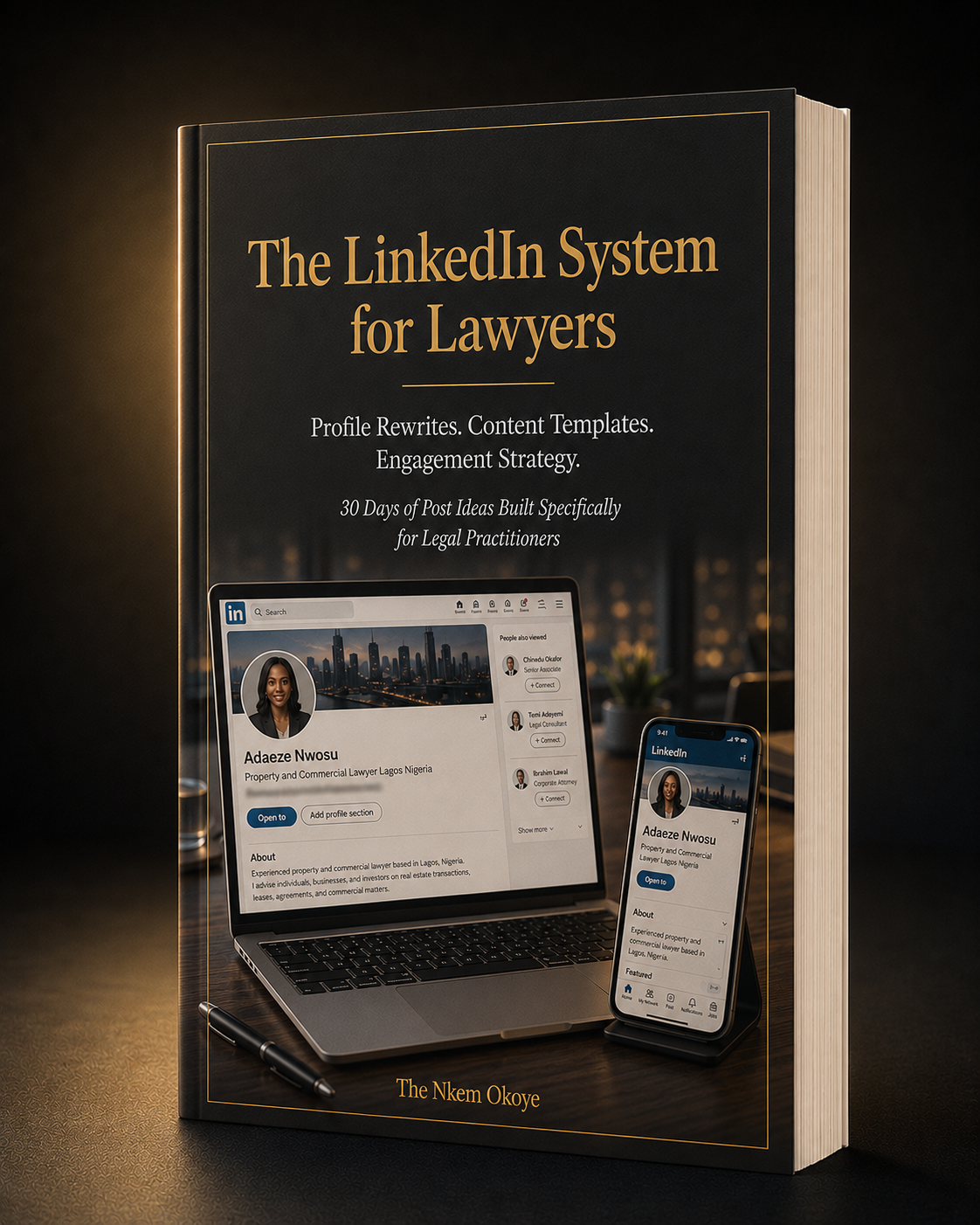
Your complete LinkedIn implementation guide. Includes a section-by-section profile rewrite guide with before/after examples for lawyers. 30 post ideas with templates — not "legal tip of the day" posts, but posts that demonstrate expertise and attract the right clients. The LinkedIn Post Anatomy breakdown. The "What Do I Even Post About?" framework so you never stare at a blank screen again. And an engagement strategy for building visibility even on weeks when you don't post.
Value: ₦15,000 — Yours FREE today.
The Professional Conduct Cheat Sheet — Extended Edition
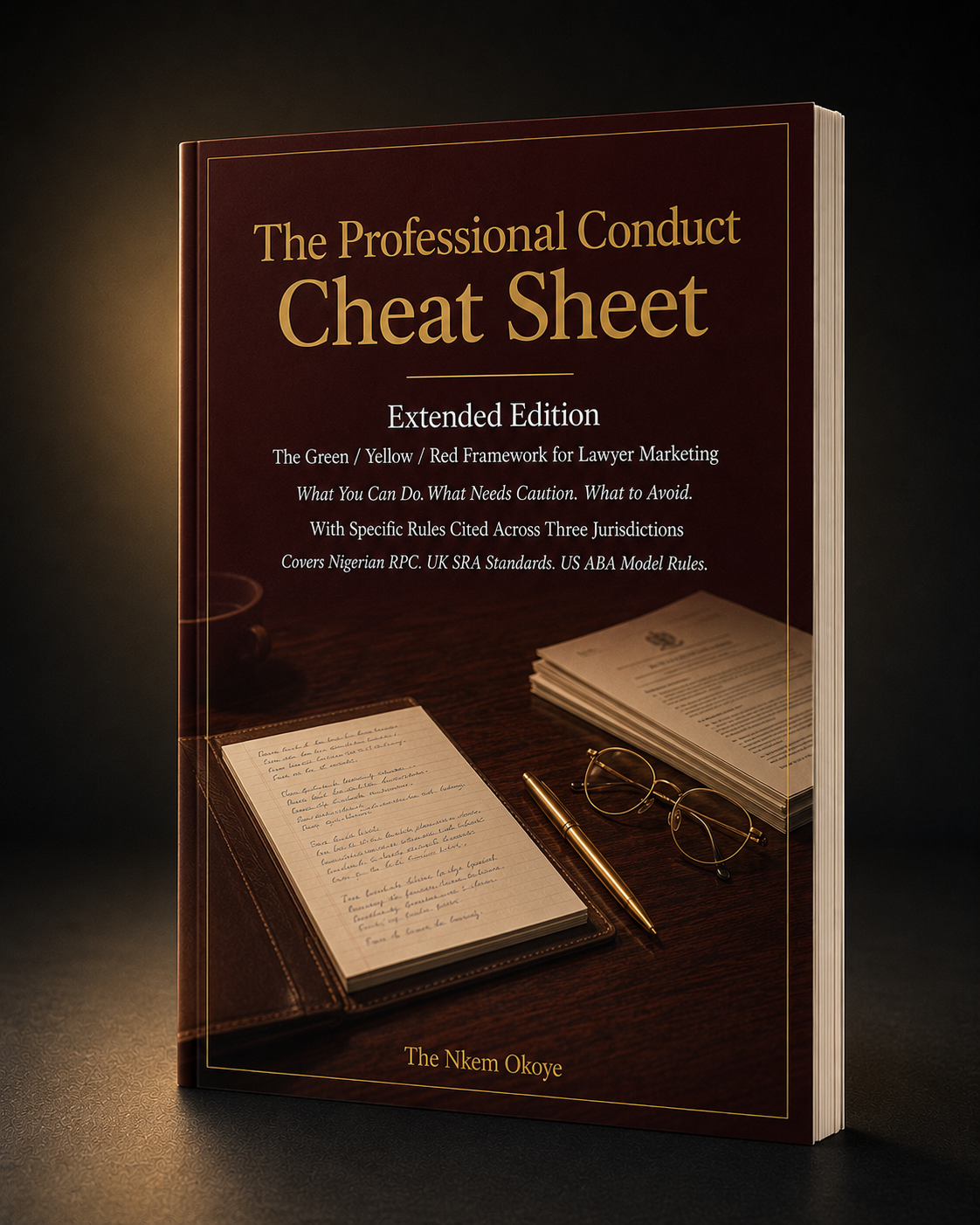
The full Green/Yellow/Red framework expanded with 20+ real scenarios lawyers encounter daily. Covers the Nigerian RPC (Rule 39 and related provisions), UK SRA Standards, and US ABA Model Rules 7.1-7.3. Includes the "Is This Okay?" 5-question quick-check you can run any piece of content through before posting. No more guessing. No more fear. Just clarity.
Value: ₦10,000 — Yours FREE today.

63 lawyers have already downloaded the system at this price.
Only 37 spots left at ₦9,800 before it goes to ₦25,000.
Bear in mind, you're not the only one viewing this page right now.
30-Day Risk-Free Guarantee
Still thinking about it? I understand. Lawyers are trained to evaluate evidence before making decisions. So here's mine.
Go through the entire system. Implement it for 30 days. If you don't see a meaningful difference in your visibility and the quality of enquiries coming in, send me one email. I'll refund every kobo. No questions. No back-and-forth.
I've watched this system work for 500+ lawyers across property, family, commercial, criminal, corporate, employment, and immigration law. In Lagos, Abuja, Port Harcourt, London, Houston, and Toronto.
I'm not worried about refund requests.
More From Lawyers Using The System
You have two options right now.
Option 1: Get the system. Implement it. Become the lawyer people think of first when they need help in your practice area. Start getting enquiries from people who found you, not people your uncle referred. Build a practice that grows because of your visibility, not in spite of your invisibility.
Option 2: Close this page. Keep being the best-kept secret in your practice area. Keep watching less skilled lawyers land the retainers, the speaking invitations, and the media features. Keep telling yourself you'll "start doing content" next month. You've been saying that for how long now?
Your call.
Questions? Email thenkemokoye@gmail.com